

Folks seem to think that Latin-based scientific names are hard to learn and unpronounceable. If you take it one step at a time – they can be easy!

A few centuries ago, Europeans started exploring this globe, and it became a much smaller place. One thing that happened was all of a sudden the common names for plants began to get really really confusing. One scientists came up with a solution, at least for his corner of the world. It was Linneaus, and he originally did it just to sort it all out in his own mind.
Linneaus’s idea caught fire, and scientists all over Europe and Russia, and even in the New World started started using this naming system that was in a neutral language that “everybody” could understand = Latin. Plants, animals, and fungi (thought to be a kind of plant) were all given Latin names.

Why Bother with Latin?
Now, why should you care? Example. Recently, in a gardening talk, a member of the audience had a question about their “jasmine bush.” Hmmm. There are seven (7) different species (in three 3 vastly different plant families) that are commonly referred to as jasmine, but most are vines, not bushes. I asked the person to come up after the talk. Then I got to see a picture of this so-called “jasmine.” It was not jasmine at all! It was a gardenia. This plant was “Gardenia jasminoides” with a common name of “Cape jasmine,” but not a true jasmine. Very different care requirements!
More about growing gardenias. Same care as camellias, azaleas, and blueberries.

If we had the scientific name of the plant (which should be on the plant label when you buy it), we could have gotten straight to the meat of the matter. Keep those plant labels! Toss them in a file folder or shoe box, and dig them out next time you have questions. Take a photo of them next to the plant.
Latin is Easy
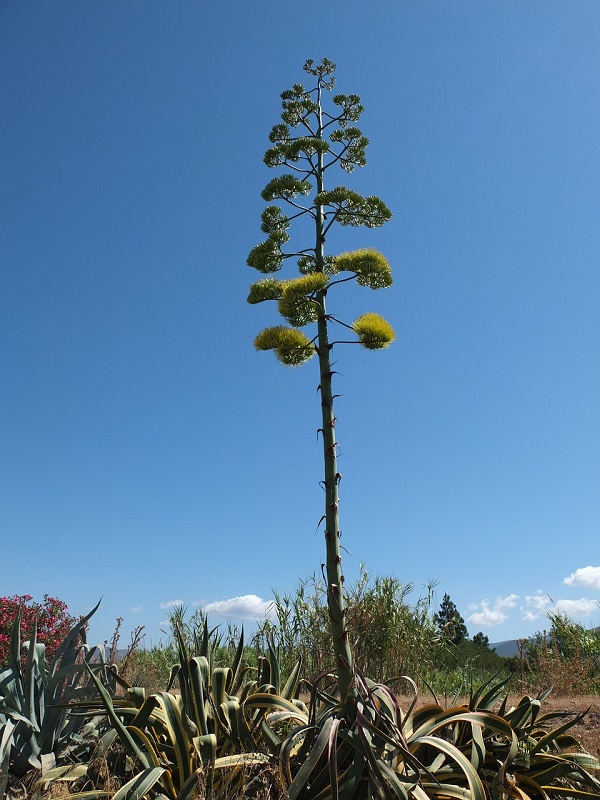
Folks seem to think that Latin-based scientific names are hard to learn and unpronounceable. Not so! You already know any number of scientific names for plants. Many “girl” names are the same as scientific plant names! (And their parents weren’t hippies!) Names like Iris, Camellia, and Erica. More scientific names you already know? From our own back yards we can start with agave, aloe, acacia, and aster. In scientific nomenclature they are Agave, Aloe, Acacia, and Aster.
Then I got to pondering, and with my writing music playing in the background, I came up with a list. This list was compiled in the length of time it took B. B. King to play a twelve-bar blues number. Putting it in alphabetical order took a tad longer.

Plants with the Same Name in English and Latin
Amaranth, amaryllis, asparagus, begonia, bougainvillea, caladium, camellia, chrysanthemum, citrus, clematis, coleus, cyclamen, dahlia, dalea, delphinium, digitalis, ephedra, eucalyptus, fatsia, forsythia, fuchsia, gardenia, geranium, gladiolus, hibiscus, hosta, hoya, hydrangea, impatiens, jacarunda, kalanchoe, lantana, magnolia, narcissus, nasturtium, oleander, penstemon, peperomia, petunia, pilea, pittosporum, pyracantha, rhododendron, sanseveria, tilia, tulbaghia, valerian, verbena, vinca, welwitschia, wisteria, xylosma, yucca, and zinnia.
Why You Should Care
How about the weeping acacias and willow acacias? Mainly from Australia, they entered the nursery trade in the U.S. in different states. Three different species are now sold as “weeping willow” acacia. One species has shallow roots that will buckle patios and knock down walls, the other two are nicely deep-rooted. To add to the confusion, there are three more species of acacia with a weeping form. Let’s get the right scientific name when we buy one for our patio so the roots don’t rearrange our life!

Botanical Latin is easy! As well as already knowing many of the names of plants, you already know many of the root words too. Take the example “pendulous.” Something hanging down, right? Like a pendulum. Make my weeping acacia that won’t rip up the patio the “Acacia pendula.“
More about Acacias
Latin Pronunciation
Remember the song – “You say to-mah-toe and I say toe-may-toe.” I say pea-can, you say pe-cahhn. IMHO, only a boor corrects the pronunciation of another (unless it’s the pronunciation of your own personal name).
Let me quote the author of the “bible” of botanical Latin, a book called “Botanical Latin,” written by William T. Stern and found on every plant taxonomists bookshelf. …”the scientific names of plants often occur in speech. How they are pronounced really matters little provided they sound pleasant and are understood by all concerned.”
The Name is Really a Binomial Name
Now we get to the part that confuses some people. A “scientific name” is actually two names. A scientific name is a “binomial.” (bi means two, like a bicycle versus a tricycle)
Take it slow and it makes sense.
Here’s an easy example. In our home Kinja Soule is a “Felis catus,” while Jacqueline Soule is a “Homo sapiens.” Which one of these two individuals is the “master” is subject to debate.
Latin names of life on earth are all binomials. One name (genus) is there to recognize the group of closely allied kin, and the second name (species) to recognize how they differ from those kin. We call the genus and species together the “name of the species.”
Going Down a Rabbit Hole
Kinja the Felis catus has a cousin running in the forests of Europe, Felis silvestris, the forest cat. (You may recognize this word because silvaculture is care of forests. ) Both Kinja and his cousin the forest cat are in the same genus. They are closely allied kin. Technically, the same genus because their genes could cross and have viable and fertile offspring. (Or they could if Kinja wasn’t neutered.)

To keep going with the closeness of kin (or not) – could a lion and a house cat have viable and fertile offspring? Simple answer = no. Lions are Panthera leo, while domestic cats are Felis catus. This makes production of viable and fertile offspring from an interspecies mating (virtually) impossible.
Keyword here is fertile. You can cross horse and donkey – animals from two different genera, but their offspring (a mule) is always sterile.

Back to that Acacia Example
Names have to be binomials. The specific name “pendula” from our acacia example above can’t stand alone. We MUST also use the genus name, “Acacia” together with the “pendula” when we talk about the deep rooted weeping acacia with the silvery blue leaves that tops out at around twenty feet, hence Acacia pendula. There are many other species that are “pendula.” like Fraxinus pendula, the weeping ash – but there is only one Acacia pendula species.
In closing, plant taxonomy, the proper names of plants, need not be taxing. It can even make your life easier! It can help you get the right plant for the right place, and then care of that plant in the right way.
Need Southwest Vegetable Garden Help?
May I recommend my book? The Southwest Fruit & Vegetable Guide offers not just growing guides but some of the latest varieties – including ones specifically for raised bed and container growing. Price is what you would pay on Amazon – only when you buy from me you get a signed copy!
From the review:
“In this updated 2nd edition of Southwest Fruit & Vegetable Gardening, you’ll find much-needed advice and practical tips on growing an edible garden, no matter which part of the southwestern US you call home.
Profits from the sale of this book go to the Arizona-based Horticulture Therapy non-profit Tierra del Sol Institute.
Legal
© Article copyright Jacqueline A. Soule. All rights reserved. You must ask permission to republish an entire blog post or article. Okay to use a short excerpt but you must give proper credit. You must include a link to the original post on our site. No stealing photos.


Thank you for this explaination of closeness of kin. it makes more sense now.