
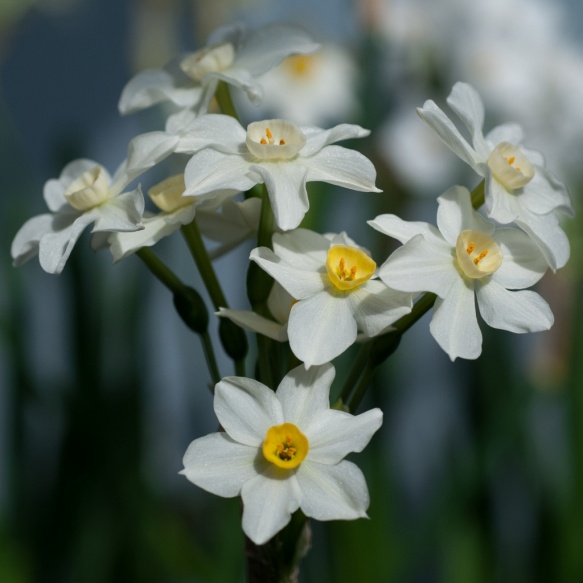
Bulb flowers are so very charming and when they appear in the yard – an enticing sign of spring. But did you know you can have bulb flowers indoors in mid-winter? It’s called “forcing” when you encourage them to flower earlier than their regular time. But very little force is involved.
Cover image: Narcissus also called paperwhites. Image courtesy Colorblends Bulbs.
Indoors and Out!
This is your reminder to order your bulbs for future flowers now, in the autumn – because now is when to plant spring flowers. We hope you will order some through the Bloomin’ Bucks (mentioned in this post) program that helps little local non-profits, like the Horticulture Therapy non-profit Tierra del Sol Institute.

Forcing Bulbs
Encouraging bulbs to flower early is termed “forcing.” It requires very little force. The process is more like coaxing, or maybe hoaxing. You have to fool the bulb into thinking it’s spring. Months early. It’s surprisingly easy.
Thrifty?
I always save my bulbs from forcing and plant them out of doors. Many of these will survive for years in the Southwest. My long ago Christmas amaryllis grown indoors now charm me every spring. And here is how to grow amaryllis outdoors.
I also have a YouTube videos if you like to watch videos. How to Grow Amaryllis.
And with my cat Kinja (the kitty ninja) Are Amarylis Safe?

How to Force Bulbs
There are just four key factors to forcing your bulbs. The right variety, the right time, proper planting (Earth, Air, Fire, Water), and good care while growing.
Step 1. The Right Variety
Get the right stuff. There are only some species that will tolerate forcing. But there are a goodly number to choose from. In a way, the fact that not all bulbs can be forced is a good thing. For me this fact prevents decision overload.
The Right Variety of Bulbs for Forcing
Listed are the weeks it will take from planting to flowering.

  amaryllis – 3 to 4 weeks
  crocus – 12 weeks
  daffodil* – 5 to 6 weeks
  gladiolus – 8 to 12 weeks
  grape hyacinth, also called muscaria – 4 weeks
  hyacinth (these are not grape hyacinth) – 10 weeks
  lily-of-the-valley – 3 to 4 weeks
  muscaria, also called grape hyacinth – 4 weeks
  narcissus* – 4 weeks
  ornithogalum, also called star-of-Bethlehem – 5 weeks
  scilla, also called squill – 4 to 6 weeks

* The flowers called “daffodil” are all in the genus Narcissus. The flowers tend to be in shades of yellow and orange. They need chilling.
The flowers called “narcissus” are all in the genus Narcissus. The flowers tend to be in shades of white. They don't need chilling.
If you decide to buy bulbs from a place where you can select individual bulbs, then pick individual bulbs that are large for their species. They have more energy stored to put into flowers. This is the reason I simply order my bulbs from Brent & Becky. They may cost more but they are nice fat bulbs.

Step 2. The Right Time
First of all – know that you can buy the bulbs now and just don’t plant them yet. They are dormant and will remain that way until activated by planting.
When do you want your home full of blooms? Christmas perhaps? Or is your birthday January 19, and you could use a bouquet then? Count the weeks back from when you want the floral display. Different species take differing amounts of time.
Step 3. Plant it Right
Bulbs for forcing are mostly desert or arid lands plants (genetically speaking) and are not happy about being overly wet. The right container is important.
Earth = Growing Media, not just soil
Soil planting. Good drainage is essential for bulbs, and container selection is key for drainage. Be sure that there are drainage holes. Big drainage holes. Use a potting soil mix that has at least one third perlite or sand. You can mix it yourself, of get a “cactus mix.”
You can also force bulbs in water. You will need a container that will hold the bulbs above water and allow only the roots to submerge. Like a dish with pebbles or colorful marbles.

Planting depth.
Forced bulbs are planted less deep than normal bulbs. Place so the top of the bulb shows three fourths above the soil. On other words – just barely planted.
Same with planting in water. Just the roots in water – the rest of the bulb needs to stay dry. Rest the bulb on top of the pretty pebbles in the dish of water.
Water = Proper watering
Part of good drainage is proper watering. Allow the soil to dry fairly well between waterings, but not bone dry. Once bulbs show green leaves, keep the soil a little more moist.

Fire & Air (Light & Temperature)

This is the coaxing part. If you purchase a bulb “prepared for forcing,” it has received any chilling required. Otherwise, bulbs will need some cool and dark time. This time is part of the “weeks to flowering,” not in addition to the weeks.
Your planted and moist bulbs need some cool and dark time. Ideally in an unheated garage or the shady north side of the house under a roomy cardboard box. A place that will not get below 45F!
The time to chill in the dimness is roughly one third of the total time to bloom, thus for those crocus that take 12 weeks to flower, they will need three or four weeks of chilling. Don’t forget to water them during forcing.
Ideally, after the one third chilling time, uncover the pot and expose to filtered or low light for another one third of the total time before your bring them indoors into full warmth. Or you can just bring them inside like I do.
Step 4. Good care while growing
Keep the soil moist but not soaking wet. Make sure the roots have water but the bulbs are not immersed. For longer lasting blooms, avoid direct sunlight. You may need to stake taller flowers.

Bulb Safety.
Many bulbs defend themselves with truly toxic defensive compounds. All of these bulbs for forcing can kill a cat, dog, or small child. In case of ingestion, always induce vomiting to get the toxins out of the body as soon as possible. Seek medical care if pet or child becomes lethargic or displays abnormal symptoms. On a positive note – these toxic bulbs are extremely bitter tasting so ingestion is rare.

Speaking of Kids
Bulbs are a great kid project. If you don’t want to try it with costly flowering bulbs, why not try forcing some onion or garlic? A small pot with garlic or onion can easily grow in the kitchen windowsill.
Subscribe to Gardening With Soule on Substack
There is a free version of my Substack newsletter, and I do hope you will subscribe. The paid Substack subscribers get an additional newsletter twice a month with special plant and gardening tips. Last year at about this time, the paid subscribers did receive a bulb forcing guide.
I produce these posts, and newsletters, and YouTube videos, and TikTok videos too – all to help you succeed with your gardening goals.

I did mention some of this in my book
The Month By Month Guide offers tips for your landscape (yes even lawns and roses) in every month of the year. I have a few copies left and am offering them to you – my loyal readers. When you buy from me you get a signed copy!
From the review:
“A great reference book is key to successful gardening in the region where you live. Arizona, Nevada & New Mexico Month-by-Month Gardening takes the guesswork out of gardening for anyone residing in the Southwest. With this book, you’ll know what to do each month to enjoy a thriving garden all year, from January to December. Chronologically organized, this guide is full of critical gardening when-to and how-to advice, along with illustrated step-by-step instructions.
The book’s author is Jacqueline Soule, a Tucson-based gardening expert. She knows this arid region inside and out, and she’s written several articles and books packed with her gardening advice. Arizona, Nevada & New Mexico Month-by-Month Gardening showcases Soule’s expertise in one easy-to-read guide.”
Profits from the sale of this book go to the Horticulture Therapy non-profit Tierra del Sol Institute.
Legal
© Article copyright Jacqueline A. Soule. All rights reserved. You must ask permission to republish an entire blog post or article. Okay to use a short excerpt but you must give proper credit. You must include a link to the original post on our site. No stealing photos.

Be the first to reply