

Aloysia are attractive to me because they are edible (appetizing!). They are attractive to pollinators as well. But best of all – they are not attractive to javelina and rabbits! This is part of my continuing series of articles that could be titled “Plant Your Yard for Pollinators and People,” as well as “Edible Landscaping.”
Aloysia can also be part of your “Moon Garden” providing fragrance and the shimmer of silvery leaves in the cool of a summer night.

April is Native Plant Month
I have been holding back on posting about aloysia because it is winter dormant and doesn’t like being transplanted when dormant. (* More about this at the end of the article.) I didn’t want to get you all excited about a plant you shouldn’t plant until later. Remember I do all my writing and videos and the like so that “you can succeed with your garden goals!”
There are hundreds of native plants with culinary, medicinal, and other herb uses – including deterring mosquitoes like lemongrass discussed last week. Many of these herbs are full of compounds that make them tasty to us but not at all tasty to wildlife like javelina and rabbits. And while the leaves repel wildlife, the flowers draw in a number of native pollinators such as butterflies and stingless native bees.

Lemon Verbena
The genus Aloysia includes lemon verbena (Aloysia citriodora). It’s a heat-loving herb from South America that the Jesuits carried around the world as part of the Columbian Interchange (more on Columbian Interchange). Lemon verbena grows into an attractive shrub, but it is not very cold tolerant. People use dried lemon verbena for refreshing lemony flavor in tea or citric tang in pot-pourri. It is also used as a sleep aid and to deter mosquitoes.

Native Aloysia
Aloysias are attractive shrubs native to scrublands and moist canyon bottoms of the southern reaches of the Southwest, from California through southern Arizona and into Texas. Aloysias were in use by native tribes long before Europeans came on the scene. In 1687, when Father Kino was sent to our area to help colonize it for Spain, he was delighted to discover numerous herbs reminiscent of European herbs, including Aloysia. Unlike many missionaries, he did not view the Native’s herbs as heathen plants to be eradicated, instead he encouraged their planting in the mission gardens and their use in the kitchens and infirmaries of the missions of this area, then known as the Pimería Alta.
White Bush
From the canyons of Mexico and the Sonoran Desert, the white bush (Aloysia lycioides) is a favorite of mine. It grows into a delicate vase-shaped shrub to 8 feet high with clusters of flowers on long stalks. Some plants have flowers tinged with a violet “throat.” Both types are appealing to pollinators and are equally fragrant. The leaves make a soothing tea that can be used instead of chamomile to relax before slumber.

Oreganillo
Also called Wright’s bee-bush (Aloysia wrightii) is found throughout western Mexico into Southern Arizona. It forms a vase-shaped shrub to around 6 feet high. Dried leaves are sold in mercados in Sonora (and Tucson!) for culinary use, and they taste great. This is one of the plants sold as “Mexican oregano.” Occasionally called bee bush or Wright’s bee bush, it is said make an excellent honey. It has stalks of small white flowers all summer long. European oregano takes more water to grow in most of the southwest.

How to Grow Aloysia
All aloysia have much the same growing needs, so I am clumping them together here. You can start aloysia from seeds, but they grow very well from cuttings. Unless you have a seed starting bench, or a cuttings bench, I find it easiest to simply purchase my plants at the nursery or from a very local plant sale – like the wonderful Tucson Organic Gardeners. They have been “soiling their hands since 1971,” and have a wonderful Plant Fair every spring and fall.

Soil
Aloysia do best in well-drained soil. They did okay in the clay soil of my previous home, but I’m a plant nerd and was very careful to not over water them, which would have lead to root rot and death.
Water
Aloysia prefer to dry out somewhat between waterings. Water like you do citrus and let them dry between watering. If the roots stay too wet, they can rot. In fact, I have planted my aloysias in and around the citrus orchard because of these similar watering needs.

Sunlight
While many herbs like plenty of sun, the aloysias all do better with part or filtered shade, especially on summer afternoons in the Southwest. The east side of your house might work well. I did plant some in full sun and they are struggling. They are also less popular with butterflies.
Temperature
With all aloysia it is best to avoid freezing. Lemon verbena may be from Argentina and Chile, but that doesn’t mean it likes to get chilly! That said, there are species from the Chihuahuan Desert that tolerate it down to 26 F without showing damage, or with just some tip damage. Consider aloysia about as tolerant to frost as lemongrass or citrus.

Space
All plants do better if they are not overly crowded. Space around each plant allows for sunlight, good air flow, ample water for the roots, and access to all the soil minerals needed. Spacing of plants out in the wild desert is due to water restraints. If you are willing to water, you could plant a hedge of aloysia. Indeed, in washes in the desert I have been faced with impenetrable hedges of the plants. A highly fragrant hedge to push through.

Pruning

If you need to shape them, or harvest leaves for herbs, this is best done just as they start to flower, or even in mid-summer. I love a good monsoon season, and so do the aloysia. I do test my hypotheses – it’s what scientists do. And yes, if you prune them when they are dormant they may not recover.
Fertilizer
Herbs in general do not need a great deal of fertilizer. Native desert herbs – next to none! After pruning or planting, wait a minimum of two weeks before fertilizing. I fertilize about three times a year, with half-strength general fertilizer.
Enjoyable Aloysia
You can easily plant aloysia in your garden, and use it in your kitchen too. Aloysias can’t be beat as lovely, low-water landscape shrubs. Shrubs that wildlife will not decimate.
Aloysia flowers are rich in nectar and are highly attractive to many pollinators, including the native docile solitary desert bees and a wide variety of native butterflies. Best of all – the bloom period is extensive! They flower from spring into fall with spikes of small, vanilla-scented flowers. Sustainable living at it’s finest!
* Botany Nerd Notes
Why can’t we transplant or prune aloysia in when dormant? We plant apple trees and prune roses when they are dormant.
Plants with tropical genes have different lives than plants with temperate climate genes. Plant families tend to be either mostly temperate or mostly tropical.
Examples:
Temperate (mostly) = rose family, carrot family, carnation family.
Tropical (mostly) = palm family, trumpet vine family, orchid family.
Global = giant families with members everywhere = sunflower family, bean family, grass family.
I may live long enough for the gene jockeys in the labs to split up those giant plant families into smaller families based on – this whole tropical//temperate gene shift thing, but I digress.

The point is – plants with tropical genes appear to have a different kind of dormancy. It is cold for them and they don’t have any mechanism for surviving the cold. Too much cold and they simply die. Many tropical plants can’t even take anything less than 45 degrees. Meanwhile many temperate plants absolutely require temperatures under 45 to form flowers and fruits. We call them chill hours.
No one has published papers about this (yet). All I can write about is years of observations and shared data from generations of desert plant ecologists. With a tip of the hat to the genial host of those Summer Solstice parties where much data is shared. I am simply sharing onward with you, gentle reader, the nature of plants with tropical genes.
Thanks for reading!
Jacqueline
More Butterfly Plants
The book Butterfly Gardening offers planting guide plus an extensive plant list for growing (mostly) native plants that the native butterflies adore. This is on my super-secure book selling site. (It that started as a membership site, but transmorgrofied.)
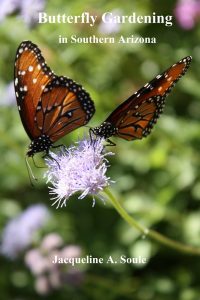 From the review:
“Bestselling local book about gardening to attract butterflies. The book covers the basics of how to get started with your butterfly garden, including tips for planting to attract these beautiful animals with “very small brains.” Award winning gardening author Dr. Jacqueline Soule includes an extensive list and guide to specific plants that will attract butterflies in the Southwest in virtually every month of the year.”
From a review:
“The book’s author is Jacqueline Soule, a Tucson-based gardening expert. She knows this arid region inside and out, and she’s written countless articles and over a dozen books packed with her gardening advice.”
Profits from the sale of this book go to the Horticulture Therapy non-profit Tierra del Sol Institute.
Legal
© Article copyright Jacqueline A. Soule. All rights reserved. You must ask permission to republish an entire blog post or article. Okay to use a short excerpt – but you must give proper credit to Gardening With Soule. You must include a link to the original post on our site. No stealing photos.


Be the first to reply